

Modrinth · Fabric, Quilt
Custom LAN auf deinem Minecraft Server
Custom LAN läuft auf Minecraft Servern mit Fabric oder Quilt. Bestell deinen Server, stell den Loader im Panel ein und installiere die Mod mit einem Klick im Mod-Browser.
Gives you more control over your integrated server through the Open to LAN menu.
- Downloads
- 301.0K
- Autor
- DimiDimit
- Loader
- Fabric, Quilt
- Minecraft
- 1.14 – 1.21.8
- Aktualisiert
- –
Einrichtung
Custom LAN auf dem Server installieren
Server und Spieler brauchen denselben Loader und dieselbe Minecraft-Version. Sichere die Welt, bevor du Mods hinzufügst oder aktualisierst.
- 01
Konfigurieren
4 GB RAM sind vorausgewählt. Laufzeit und Add-ons wählst du selbst, bezahlt wird per Kreditkarte oder PayPal.
- 02
Loader einstellen
Stell im Panel die Serversoftware auf Fabric oder Quilt und wähl die passende Minecraft-Version, zum Beispiel 1.21.8.
- 03
Mod installieren
Such im Mod-Browser nach „Custom LAN“ und installiere die Version für deinen Loader. Alternativ lädst du die .jar per SFTP in den Ordner mods. Erforderliche Abhängigkeiten stehen auf der Projektseite.
- 04
Verbinden
Alle Spieler installieren Custom LAN in derselben Version lokal und verbinden sich über die Serveradresse aus dem Panel.
- Auf dem Server
- Erforderlich
- Auf dem Client
- Erforderlich
- Loader
- Fabric, Quilt
- Minecraft
- 1.21.8, 1.21.7, 1.21.6 +37 weitere
- Lizenz
- MIT License
Das Panel
Mods installieren, Fehler finden.
Echte Screenshots aus dem Mado Panel. Beides ist bei jedem Minecraft Server enthalten.
Mod-Browser
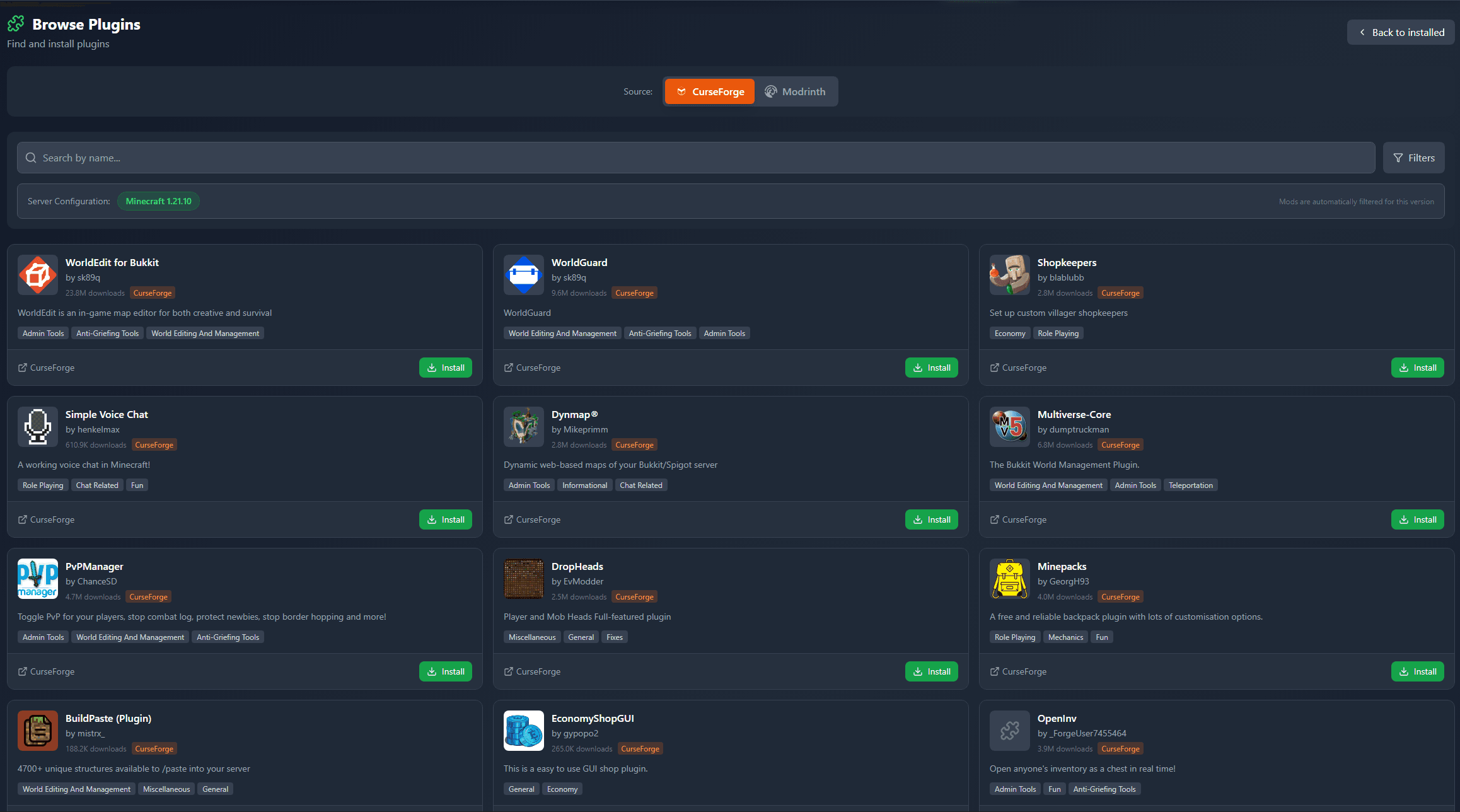
Modrinth und CurseForge direkt im Panel.
Der Browser filtert nach deiner Minecraft-Version. Mods installierst du mit einem Klick, ohne .jar-Dateien hochzuladen.
KI-Crash-Analyse
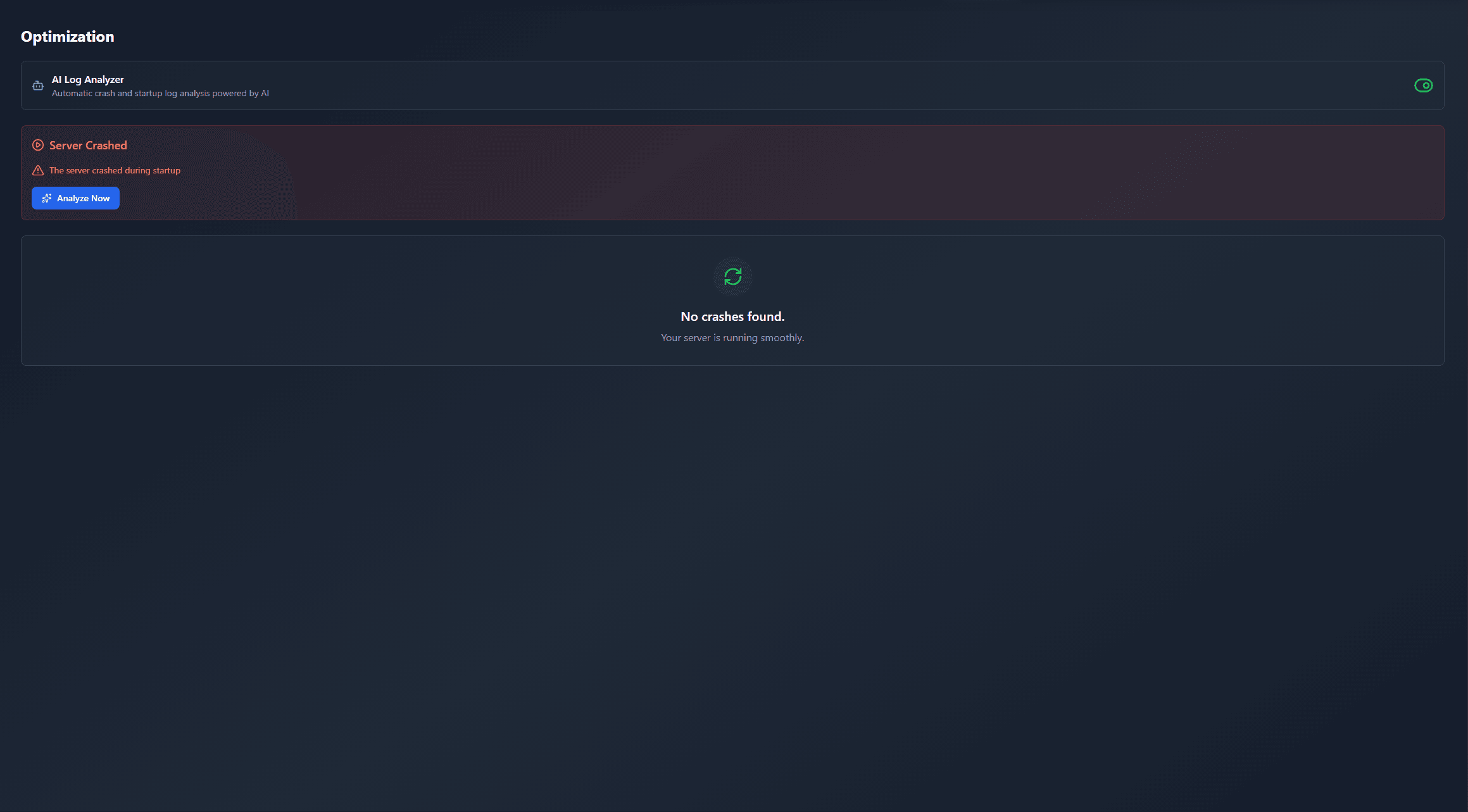
Wenn ein Mod crasht, liest die Analyse das Log.
Mods scheitern oft an einer falschen Loader-Version, Java-Version oder fehlenden Abhängigkeit. Die Analyse nennt eine wahrscheinliche Ursache und einen Lösungsvorschlag.
Versionen
Veröffentlichte Versionen
Nimm die Datei, die zu Loader und Minecraft-Version deines Servers passt. Server und Spieler brauchen dieselbe Version.
Custom LAN · Modrinth- [1.21.6-1.21.8] Custom LAN 2.3.226. Juli 2025Minecraft 1.21.6, 1.21.7, 1.21.8 · Fabric, Quilt
- [1.21.5] Custom LAN 2.3.214. April 2025Minecraft 1.21.5 · Fabric, Quilt
- [1.21.4] Custom LAN 2.3.22. Januar 2025Minecraft 1.21.4 · Fabric, Quilt
- [1.21.2-1.21.3] Custom LAN 2.3.225. November 2024Minecraft 1.21.2, 1.21.3 · Fabric, Quilt
- [1.21-1.21.1] Custom LAN 2.3.220. Oktober 2024Minecraft 1.21, 1.21.1 · Fabric, Quilt
Originalbeschreibung des Projektautors

A Fabric mod that allows you to:
- Customize more of your integrated server (Online Mode, PvP, Max Players, MOTD)
- Use ampersands (
&) for formatting codes instead of section signs (§) and variables (e.g.${username},${world}) in the MOTD - Change the settings mid-game (including the port) and stop the server without quitting the world
- Save the settings globally or per-world (they are loaded automatically with per-world settings taking priority over the global ones, which take priority over the system defaults)
- Change who can use cheats individually using the
/opand/deopcommands and cheat in singleplayer without opening to LAN (replaces the Allow Cheats button) - Manage bans with
/ban,/ban-ip,/banlist,/pardonand/pardon-ip, and whitelist players with/whitelist(use/whitelist on/offto enable/disable) - Expose your server outside of your LAN without port forwarding using tunnels (currently only ngrok is supported)
It also allows you to start the LAN world by pressing Enter, doesn't force the gamemode (e.g. anyone who left in Creative mode will still be in Creative when they join even if the world is set to Survival), and extends the /publish command, which can now change settings mid-game as well (use a port of -1 to randomize it):
/publish [<port>] [<onlineMode>] [<pvpEnabled>] [<maxPlayers>] [<defaultGameMode>] [<tunnel>] [<motd>]
/publish [perworld|global|system] [<port>] [<onlineMode>] [<pvpEnabled>] [<maxPlayers>] [<defaultGameMode>] [<tunnel>] [<motd>]
/publish stop
It requires Fabric Loader and Cloth Config API, but Fabric API is not required.
It has been backported to all Minecraft versions supported by Fabric (except the snapshots)!
I'm not planning on porting it to Forge myself for now, but you're more than welcome to send me a pull request.
Explanation of MOTD formatting codes and variables
In the MOTD, ampersands (&) are replaced with section signs (§) to allow you to enter formatting codes (e.g. &9Hello, &a&lworld! makes Hello, blue and world! green and bold).
You can use two ampersands in a row (&&) to get an actual ampersand (&).
The following variables will be expanded using Apache Commons Text's StringSubstitutor:
${username}– the host's username (e.g. “DimiDimit”)${world}– the world's name (e.g. “New World”)
Explanation of saved settings
The settings can be saved per-world or globally. When the Open to LAN screen is opened, the settings are loaded automatically in that order, and they can also be loaded manually using the Load buttons.
Using the /publish command without specifying which saved settings to use (perworld, global or system) uses the same order if the world hasn't been opened to LAN, or the current values instead of any saved settings if it has.
Specifying the saved settings uses those particular settings or the system defaults if they haven't been saved, without checking any others, even if the world has been opened to LAN (e.g. if perworld is specified and no per-world settings are saved, the system defaults will be used even if there are saved global settings).
The settings specified as arguments will override the saved settings or current values (e.g. /publish perworld 12345 false will use the per-world settings, except that the port will be 12345 and online mode will be disabled).
The global settings are stored in .minecraft/config/customlan.toml, while the per-world ones are stored in data/customlan.dat in the respective world's directory.
Explanation of /op and /deop
/op and /deop work like in dedicated servers.
You can also use them on yourself, the host. Doing this will add/remove the “Cheats” label on the world (as if you've NBT edited the allowCommands field), and you can use these commands without opening to LAN as well, replacing the Vanilla method of opening to LAN, cheating, quitting the world and entering it again.
Operators are persisted per-world in an ops.json file inside that world's directory. To allow operators to assign and remove other operators, as well as ban and whitelist players, change their level in the ops.json file to 3 or higher (the default is 2, while level 4 allows them to use /publish). You, as the host, can always assign and remove operators, even if you're not an operator yourself.
Explanation of bans and whitelists
These commands also work like in dedicated servers, though you cannot ban or whitelist the host.
Enabling the whitelist does not kick all non-whitelisted players (i.e. enforce-whitelist is always false).
The files used are also per-world and the same as on dedicated servers—banned-players.json, banned-ips.json, whitelist.json—though whether the whitelist is enabled is stored in data/customlan.dat.
Custom LAN Server crasht beim Start – was tun?
Häufige Ursachen: Loader- oder Minecraft-Version passen nicht zur Mod-Datei, eine Abhängigkeit fehlt oder der RAM reicht nicht. Such im Log (latest.log) nach „OutOfMemoryError“, „Mixin“ oder fehlenden Mods. Bei Mado wertet die KI-Crash-Analyse das Log aus und schlägt eine Ursache vor. Loader und Version änderst du im Panel.
Mit welchem Loader läuft Custom LAN?
Laut Modrinth unterstützt Custom LAN Fabric, Quilt für Minecraft 1.21.8, 1.21.7, 1.21.6.
Wie viel RAM braucht ein Server mit Custom LAN?
Als Orientierung 3–4 GB für einen Server mit dieser Mod. Das ist eine Schätzung, keine gemessene Mindestanforderung. Weitere Mods, viele Spieler und große Sichtweiten brauchen mehr. Ob eine Mod die Tick-Zeit belastet, siehst du mit dem spark-Profiler.
Ähnliche Mods
Beliebte Mods aus derselben Kategorie
 Server-fähig

FerriteCore
von malte0811
Memory usage optimizations
 Nur Client

Mod Menu
von Prospector
Adds a mod menu to view the list of mods you have installed.
 Server-fähig

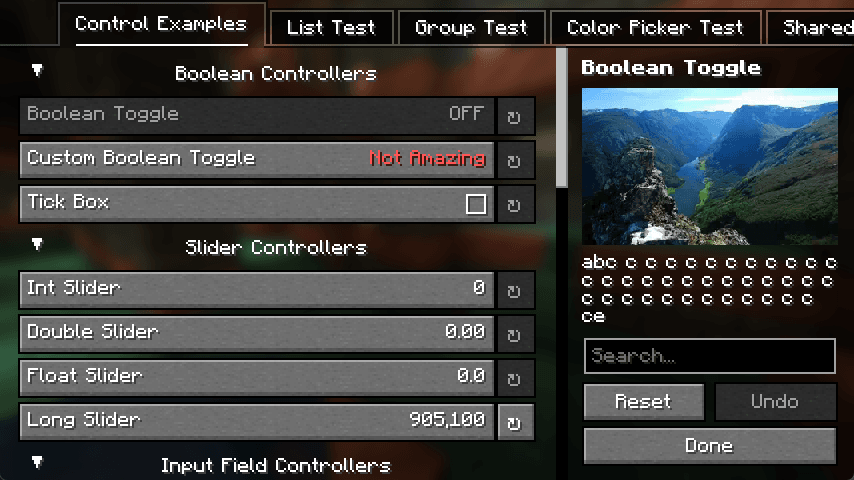
YetAnotherConfigLib (YACL)
von isxander
A builder-based configuration library for Minecraft!
 Server-fähig

Xaero's Minimap
von thexaero
Displays a map of the nearby world terrain, players, mobs, entities in the corner of your screen. Lets you create waypoints which help you find the locations you've marked.
Bereit für deinen Server mit Custom LAN?
4 GB RAM ab 8,00 € im Monat. 35 % auf den 1. Monat mit MADO35.