
Recursive Resources
Enhances the Resource Pack menu with folder support.
Screenshots
Über diese Mod
Recursive Resources
An opinionated port of the Resource Pack Organiser mod to modern versions of Minecraft.
Summary
Recursive Resources is a mod that revamps the vanilla resource pack menu to be more friendly to power users
with the addition of many Quality of Life features, such as:
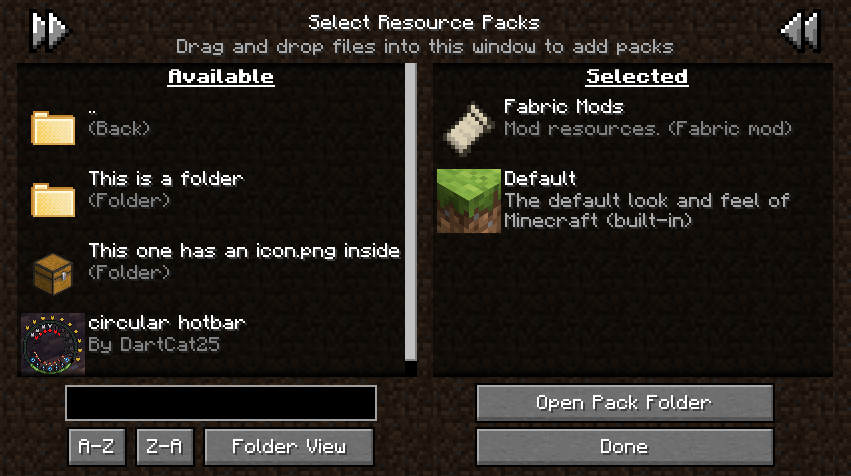
- The ability to organize resource packs into folders that you can navigate within the game
- Extensive folder customization including custom icons, ordering and pseudo-symlinking
- Enabling full folders of resource packs at once, effectively creating "profiles"
- Folder view (navigate in and out of folders) and flat view (packs from all folders shown in a single list)
- Searching pack names and description (with wildcard support)

Features
Folders
Most of the features in this mod revolve around folders.
Unlike vanilla, any subfolders you create in the .minecraft/resourcepacks folder will be shown ingame,
letting you navigate in and out of them to select packs.
Due to technical limitations, this mod cannot create or manage folders or move packs ingame,
this must be done via an external file browser.
Any changes you make to the directory structure will be updated in realtime ingame.

Note: Unzipped resource packs will still be properly detected and shown in the list as a resource pack.
Quick enable/disable
You may have noticed the new buttons added to the top of the resource pack list.
These can be used to quickly enable or disable all resource packs in the current folder.
A similar button can also be seen by hovering over the icon of a folder,
which will enable all packs in that folder.
Packs enabled this way will apply in the order they appear in the folder,
this order can be customized using the folder.json files as described below.


Folder icons
You can give folders custom icons by placing an image named icon.png inside them.
This image will be shown in the resource pack list, and can be used to quickly identify folders.

folder.json configuration
You've probably seen a file named folder.json in the screenshots above,
this file is used to configure some extra properties for the folder it is inside of.
One of these files will be automatically created when you create and enter a new folder.
Opening it up in a text editor, you should see a structure similar to this:
{
  "icon": "icon.png",
  "description": "",
  "packs": [
    "circular hotbar.zip",
    "Not Microsoft"
  ],
  "hidden": false
}
These fields represent the following:
icon- The name of the icon file to use for this folder, relative to this folder.description- A description of the folder, shown under its name.hidden- Whether or not to hide this folder from the list.
The packs field is a little more complicated.
It contains a list of all packs in the current folder, in the order in which they'll be displayed and applied.
While you can reorder these as you please,
removing one will cause it to be added back automatically so long as its file is still in the folder.
Pseudo-symlinks
In some cases, you may want to have a pack appear in multiple folders at once.
While you could just copy the pack, this would use twice the disk space, and might be impractical.
This is why the packs field in the folder.json supports referencing packs outside of the current folder.
For example, you could modify the folder.json from the above examples like this:
{
  "icon": "icon.png",
  "description": "",
  "packs": [
    "vanillatweaks packs/VanillaTweaks_general.zip",
    "circular hotbar.zip",
    "Not Microsoft"
  ],
  "hidden": false
}
This would cause the VanillaTweaks_general.zip pack to appear in
both the vanillatweaks packs folder and the current folder:

License
This mod is under the Mozilla Public License, version 2.0
Verfügbare Versionen
Recursive Resources auf deinem Client installieren
Mod-Loader lokal installieren
Installiere fabric für deine lokale Minecraft-Version.
Passende Datei herunterladen
Wähle die Recursive Resources-Datei für fabric und Minecraft 1.21.7.
Mod installieren
Lege die .jar-Datei in deinem lokalen .minecraft/mods-Ordner ab und starte Minecraft neu. Eine Installation auf dem Server ist nicht nötig.
Kompatibilität
Mod-Loader
Minecraft-Versionen
1.21.7, 1.21.6, 1.21.4 (+15 weitere)
Server-seitig
✗ Nicht unterstütztEmpfohlener RAM
4 GB(min. 3 GB)Häufige Fragen
Muss Recursive Resources auf dem Minecraft Server installiert werden?
Nein. Modrinth kennzeichnet Recursive Resources serverseitig als nicht unterstützt. Installiere die Mod nur im lokalen Minecraft-Mods-Ordner. Dein Server kann unverändert bleiben, sofern die Mod-Seite keine zusätzliche Abhängigkeit nennt.
Welche Version und welchen Loader braucht Recursive Resources?
Nutze eine Datei für fabric und exakt deine Minecraft-Version. Unterstützte Versionen sind unter anderem 1.21.7, 1.21.6, 1.21.4. Loader-Dateien sind nicht untereinander austauschbar.
Recursive Resources funktioniert nicht – was kann ich prüfen?
Prüfe zuerst Minecraft-Version, Loader-Version und erforderliche Abhängigkeiten. Lege die .jar-Datei im lokalen .minecraft/mods-Ordner ab und entferne ältere Duplikate. Da die Mod clientseitig ist, löst mehr Server-RAM dieses Problem nicht.
Ähnliche Mods





Minecraft Server für deine Gruppe
Recursive Resources bleibt auf deinem Client. Hoste dazu eine kompatible Welt für deine Mitspieler.